

Lately, there’s been some noise in the headlines about the Federal Reserve and its relationship...
2026 Market Outlook: Key Trends and Insights for Investors


Every year brings a fresh set of predictions, worries, and headlines. And every year, markets remind us that most of what investors fear never plays out as dramatically as expected. I’ve never believed that reacting to headlines is a productive way to manage money. The day-to-day noise has very little to do with long-term results. What I try to do instead is focus on perspective. Strong returns across many parts of the market have put investors in a better position than they may feel, yet elevated valuations, shifting policy, and slower economic growth call for a grounded approach.
Here’s how I’m thinking about the landscape as we enter the new year.
A broader market has finally shown up

For most of the past decade, U.S. large-cap stocks carried the load. In 2025, that changed. International markets delivered meaningful performance thanks to improving growth abroad and a weaker dollar. Bonds contributed as well, offering stability and income as rates declined and inflation cooled.
For me, this reinforces a lesson that often gets lost when U.S. stocks dominate the headlines: diversified portfolios work. You don’t need to anticipate the next big story. You need an allocation that is resilient across different cycles.
Valuations are stretched, and that affects expectations
There is no ignoring the fact that U.S. stocks are expensive by historical standards. When prices rise faster than earnings, future returns often slow. That doesn’t automatically set the stage for a downturn. Expensive markets can continue higher. It does mean markets become more sensitive and less forgiving of disappointment.
This brings me to a topic that has been impossible to avoid.
AI enthusiasm is real, but it needs context
I do not believe everything tied to AI is a bubble waiting to burst. Transformative technologies often move through a phase where the excitement outpaces the economics. We saw this pattern during the rise of railroads, the early internet companies, and later with cloud computing. The underlying innovation ended up reshaping entire industries, even if the early market pricing ran ahead of the actual profits.
What gives me pause today is not the technology itself but the pace of investment and the assumption that profitability will arrive quickly. Companies are pouring extraordinary sums into data centers, chips, and infrastructure. Some deals look circular on the surface, and that tends to invite skepticism. At the same time, real adoption is growing, and the economic impact is no longer theoretical. The challenge for investors is separating long-term promise from short-term expectation.
This is where a thoughtful allocation matters. Owning the future is important, but no single theme should be allowed to dominate a portfolio. My responsibility is to help clients capture long-term innovation without letting enthusiasm for any one area overwhelm the broader plan. Good investing requires exposure, not overexposure.
Economic growth is slowing but still constructive
The economy is not running at full speed, yet it also isn’t flashing recession signals. Growth has moderated. Costs are still pinching households. Different parts of the economy are moving at different speeds. The real unknown is productivity. If technology helps workers produce more with fewer inputs, that can support earnings and growth for years. But productivity shifts rarely happen overnight. I’m not building plans around an instant transformation.
Tariffs may grab headlines but haven’t derailed the economy
Tariffs were a major source of volatility in 2025, yet their economic impact has been far less severe than many expected. Some were paused, some were absorbed by companies, and some were overshadowed by strength in other sectors. Tariffs remain a policy tool, not a signal that the global system is collapsing.
Elections, debt, and policy shifts will stir emotions
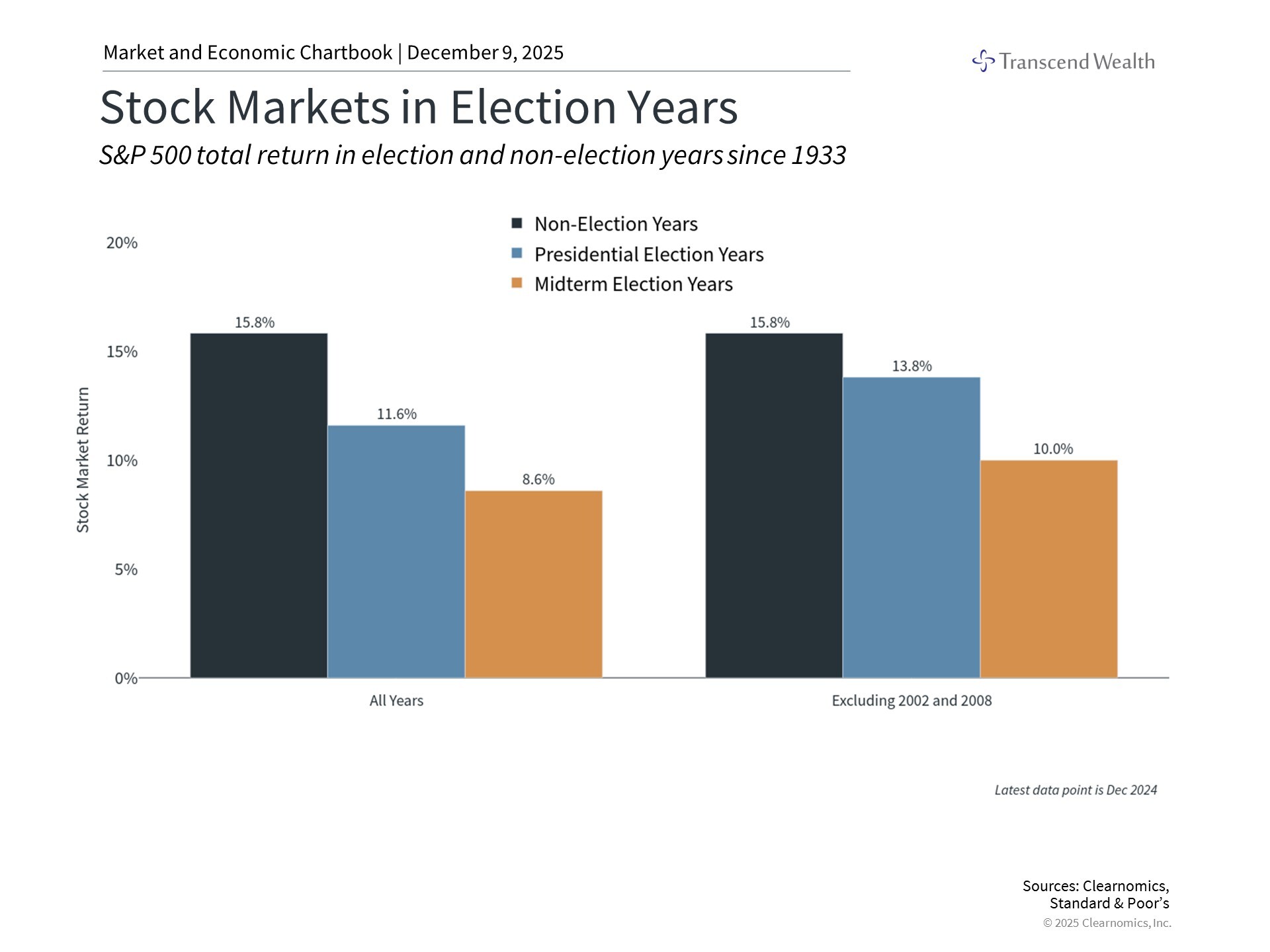
A midterm election, a possible government shutdown, and new Federal Reserve leadership will all create noise in 2026. Concerns about the national debt will continue as well. Investors feel these stories, but historically, markets have moved through every political cycle we have seen. What matters more than the headlines is understanding how new tax rules affect planning. That is where families can take meaningful action.
The Fed is shifting from fighting inflation to managing balance
The Fed has begun cutting rates again. I expect more incremental adjustments rather than dramatic ones. Long-term rates, the ones that matter most for retirement planning, will still be shaped by growth, inflation, and productivity rather than day-to-day commentary.
Perspective matters more than prediction
As we step into 2026, the real challenge is not decoding every chart or headline. It’s remembering that markets have rewarded patience and discipline far more reliably than prediction. Returns may moderate. Volatility may rise. None of that is unusual.
My goal, for myself and for the families I serve, is to stay focused on what we can actually control: thoughtful planning, smart tax decisions, appropriate risk, and portfolios designed for a wide range of outcomes.
The noise will keep coming. It always does. But clarity and steadiness tend to win over time.